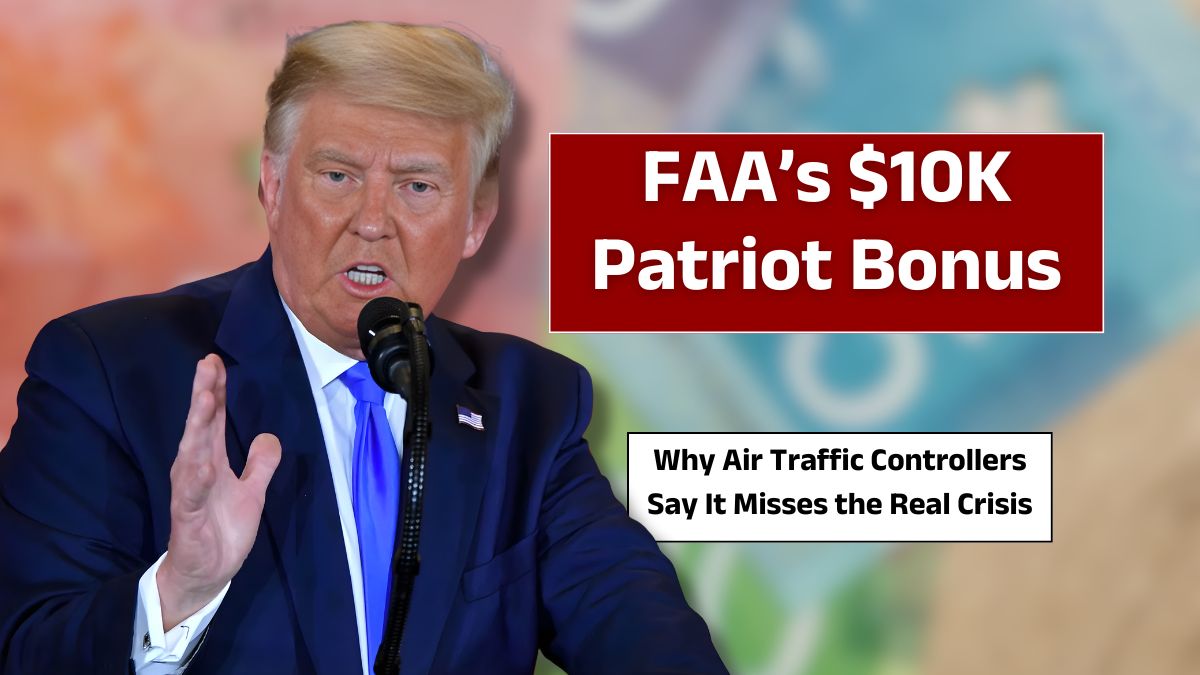
The FAA likely expected applause when it announced a $10,000 one-time “patriot bonus.” Instead, it has triggered anger and disbelief among air traffic controllers who say the gesture ignores the real problems pushing the system toward the edge.
FAA Administrator Bryan Bedford and Transportation Secretary Sean Duffy revealed the bonus for air traffic controllers and technicians who maintained perfect attendance while working unpaid during the 43‑day government shutdown. Out of roughly 20,000 eligible workers, only 776 people, less than 8 percent, qualify.

For many controllers, that number alone explains why the bonus feels hollow.
Bonus
On paper, $10,000 sounds generous. In reality, controllers say it feels symbolic at best and insulting at worst.
Many ATCs argue the bonus rewards endurance during a shutdown but completely sidesteps why endurance has become such a problem in the first place. Chronic understaffing, mandatory overtime, unpredictable schedules, and aging technology have defined the job for years.

“It feels like a slap in the face,” one controller told Guessing Headlights. Another said colleagues routinely work six-day weeks, ten-hour shifts, and rotating schedules on outdated systems that make an already stressful job even harder.
Problems
Retired controllers Jim Gee and Steven Meitz say the backlash is not about jealousy over who got paid. It’s about decades of unresolved issues that a one-time check cannot fix.
Here is what controllers say is actually driving burnout and exits:
| Long-term issue | Effect on controllers and travelers |
|---|---|
| Outdated technology | Radar and tower systems lag behind modern global peers. |
| Staffing shortages | FAA employs under 11,000 controllers; about 14,600 needed. |
| Fatigue and attrition | Long hours and forced overtime push workers to leave. |

With staffing levels so low, the remaining controllers carry heavier workloads, raising both safety concerns and stress levels.
History
According to Meitz, today’s staffing crisis is the result of compounding decisions over decades.
The 1981 firing of more than 11,000 striking controllers under President Reagan set the system back dramatically. Hiring freezes after the 2008 financial crisis slowed recovery. More recently, the pandemic, early retirements, and the government shutdown accelerated departures.
Training new controllers is not quick or easy. Both Gee and Meitz note that it takes two to four years before a controller can safely work alone. Transportation Secretary Duffy has also acknowledged that some trainees are dropping out of the FAA academy as stipends fall short and the reality of long hours sinks in.
Solutions
When asked what would actually help, controllers and unions like NATCA offer a consistent list. It has nothing to do with one-off bonuses.
They want:
- Higher base pay that reflects responsibility and stress
- Predictable schedules instead of rotating shifts
- Faster and larger-scale hiring
- Overtime rules that reduce fatigue
- Shorter, more efficient training pipelines
- Modern equipment and safer facilities
To many controllers, these changes would do more for morale and safety than any “patriot” check.
Funding
There are signs of movement, though progress feels slow to those on the front lines. Congress has approved $12.5 billion for aviation safety and infrastructure, and officials say another $19 billion is still needed. The FAA has outlined plans to hire nearly 9,000 new controllers by 2028.
Even so, many controllers see the bonus as a band‑aid on a decades-old wound. As Jim Gee put it, today’s workforce is “a little bit beaten down,” and gestures of gratitude do not address the exhaustion baked into the job.
The FAA’s $10,000 patriot bonus may have been intended as a thank-you. For most air traffic controllers, it landed as a reminder that applause and checks cannot replace staffing, rest, and modern tools. Until those issues are tackled head-on, frustration inside America’s control towers is unlikely to fade.
FAQs
Who qualifies for the FAA’s $10K patriot bonus?
Only 776 workers with perfect shutdown attendance qualify.
Why are air traffic controllers upset?
They say the bonus ignores staffing, fatigue, and safety issues.
How big is the ATC staffing shortage?
FAA has under 11,000 controllers but needs about 14,600.
How long does it take to train a controller?
Training typically takes two to four years.
What do controllers want instead of bonuses?
Higher pay, more hiring, better schedules, and modern equipment.