

In the 1970s and 1980s, something quietly revolutionary was happening in concert halls across Europe and beyond. While most orchestras were focused on romantic and modern works, a new movement was gaining traction — one that sought to rediscover the music of the Baroque and Classical eras and perform it the way it was meant to be heard.
At the forefront of this movement? Trevor Pinnock — harpsichordist, conductor, and early music trailblazer. His work during this time didn’t just breathe new life into centuries-old scores; it reshaped how audiences and musicians thought about classical music.
Roots
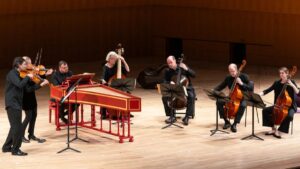
The idea behind the early music revival was simple: Play music as close as possible to how it would have sounded when it was written. This meant smaller ensembles, period instruments (or replicas), and historically informed performance practices.
Trevor Pinnock was part of a new generation of musicians eager to move away from lush, modern interpretations of Baroque music. Instead, he championed authenticity, energy, and precision.
After studying at the Royal College of Music, Pinnock became fascinated with the harpsichord and its role in ensemble music. It was there that his passion for historical performance took root.
Ensemble
In 1972, Pinnock founded The English Concert, one of the most influential period-instrument ensembles of the 20th century. At the time, this was a radical move. Most orchestras were playing Baroque music using modern instruments, often in a grand, romanticized style.
The English Concert was different. Using instruments appropriate to the time of the music — such as gut-string violins, Baroque oboes, and natural horns — they delivered a fresh, transparent sound that was lighter, quicker, and more rhythmically driven than what most audiences were used to.
Their concerts and tours across Europe and the U.S. helped popularize this new (yet old) approach to performance.
Recordings

Trevor Pinnock’s recordings with The English Concert played a massive role in spreading the early music revival to a global audience.
In partnership with Archiv Produktion (a prestigious early music label under Deutsche Grammophon), Pinnock released dozens of albums that became benchmarks for historically informed performance.
Some iconic recordings from this era include:
| Album | Year | Highlights |
|---|---|---|
| Bach: Brandenburg Concertos | 1982 | Vital, dance-like, and historically precise |
| Handel: Water Music & Music for Royal Fireworks | 1983 | Crisp phrasing, sparkling textures |
| Vivaldi: The Four Seasons | 1984 | Quick tempos, vivid dynamics |
These albums weren’t just critically acclaimed — they were hugely popular, making Baroque music cool again and introducing a generation of listeners to composers like Bach, Handel, and Vivaldi in a new light.
Influence
The ripple effect of Pinnock’s work in the 70s and 80s was enormous. Alongside other pioneers like Christopher Hogwood, John Eliot Gardiner, and Nikolaus Harnoncourt, Pinnock helped turn what was once a niche interest into a mainstream movement.
Conservatories began offering courses in historical performance. Major symphony orchestras started inviting early music specialists to lead Baroque programs. And new ensembles, inspired by The English Concert, began to spring up around the world.
Thanks to this revival, today’s audiences are used to hearing Bach cantatas, Handel operas, and Vivaldi concertos performed in historically accurate styles — something that was nearly unheard of before the 1970s.
Style
What made Pinnock stand out was his balance between scholarship and spontaneity. While he was deeply committed to historical research, he never let it overpower the emotional power of the music.
His conducting style was engaged and energetic, often leading from the harpsichord. Instead of heavy-handed interpretations, he focused on clarity, rhythmic drive, and allowing the music to speak for itself.
Audiences loved it. Critics praised it. And fellow musicians respected it.
Legacy
Trevor Pinnock’s contribution to the early music revival is undeniable. Through his recordings, concerts, and teaching, he helped turn a fringe academic movement into a major part of the classical music landscape.
The 1970s and 1980s were a turning point, and Pinnock was one of the key figures who made it happen. He didn’t just revive early music — he reinvigorated it, and in doing so, gave it a place on the modern concert stage where it still thrives today.
FAQs
What is the early music revival?
A movement to perform Baroque and Classical music authentically.
Who founded The English Concert?
Trevor Pinnock founded it in 1972.
Why were Pinnock’s recordings important?
They popularized Baroque music using period instruments.
Which label did Pinnock record with?
Archiv Produktion under Deutsche Grammophon.
What made Pinnock’s style unique?
He combined historical accuracy with emotional expression.